
The Format Frontier: Where bioavailability meets consumer health
From liposomal delivery to buccal pouches to transdermal patches, the frontier of consumer health is no longer about what you take. It's about how.


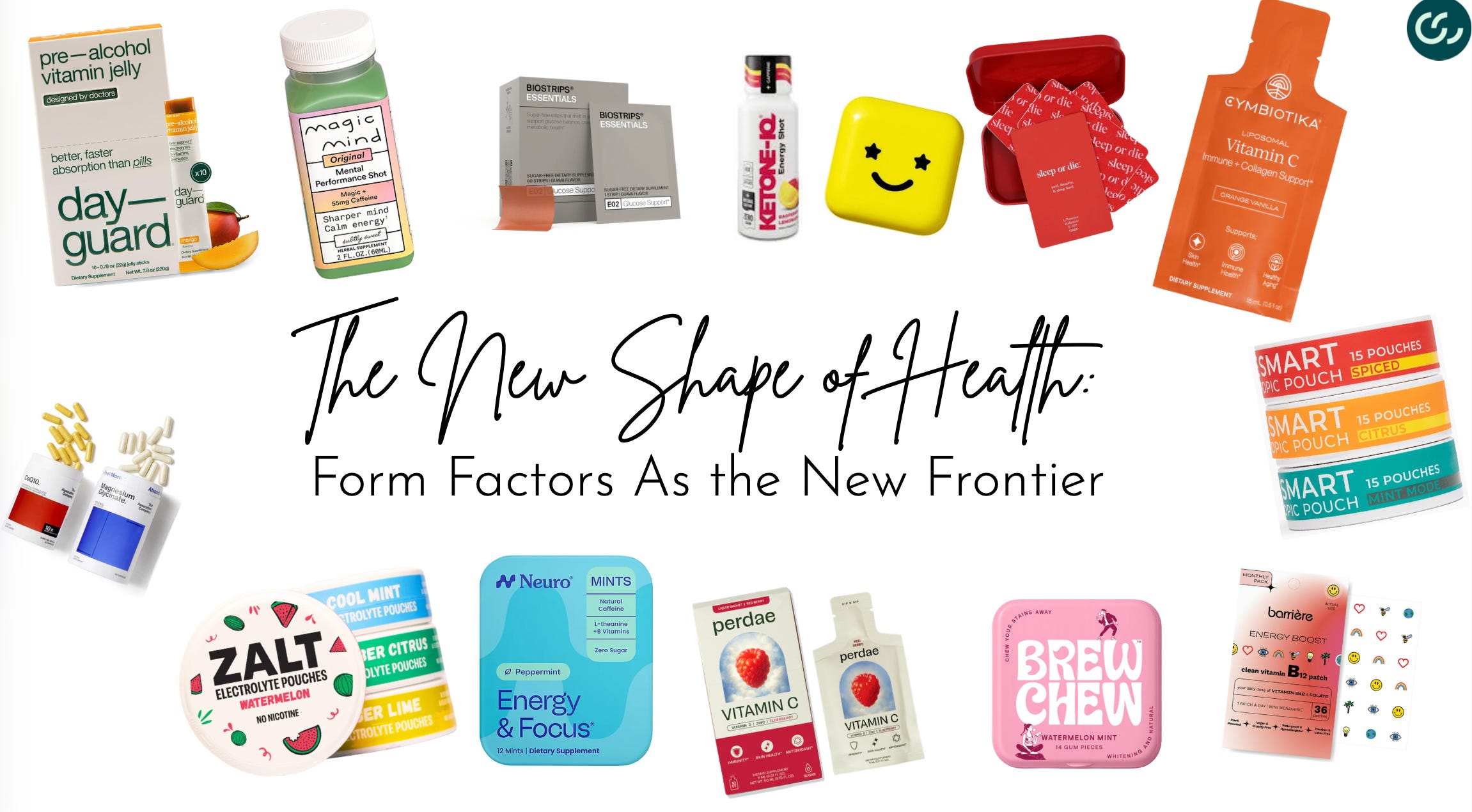
There’s a quiet revolution happening in the supplement aisle. This time, it’s not about the next breakout ingredient or a celebrity-backed brand. It’s more fundamental than all of that. It’ll be about the form factor – the physical architecture through which a nutritional compound is absorbed into the human body. And increasingly, it’s about whether this architecture is able to compete in a sea of competitors looking to cement themselves as the next culturally item earning a permanent place in someone’s morning routine.
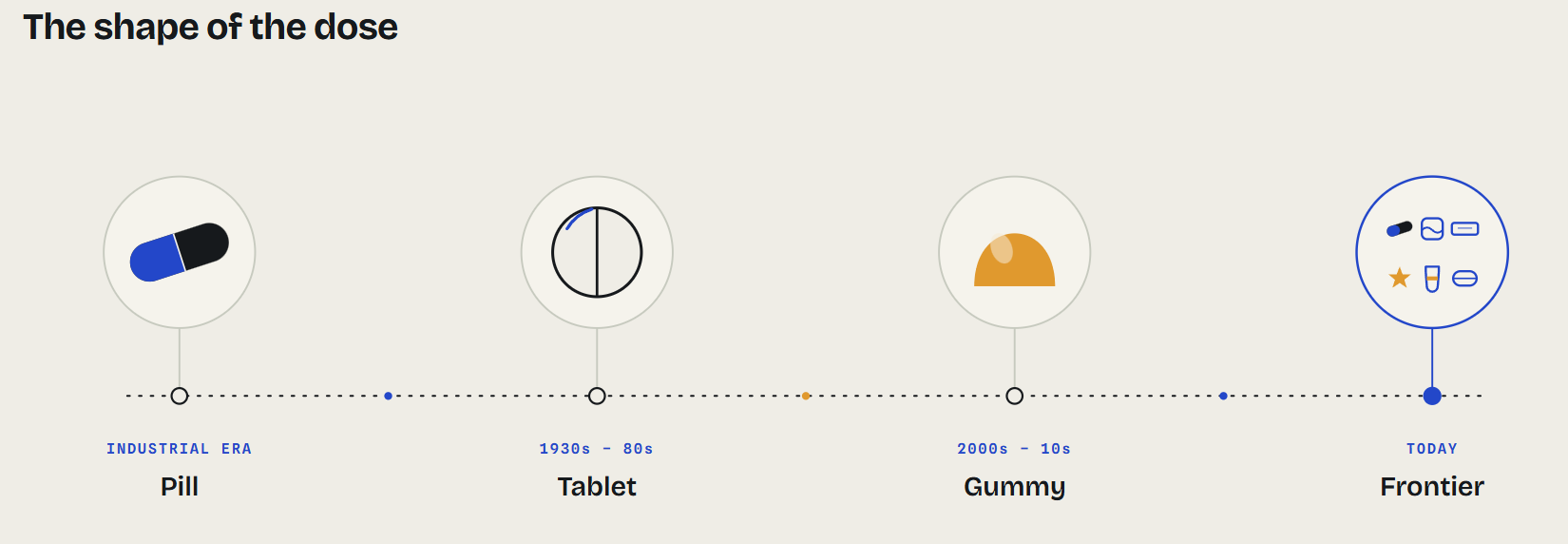
To understand where we’re going, let’s take a step back to see how far we’ve come. For a large portion of modern history, the pill has been the standard supplement form factor. Its mechanized mass production methods during the Industrial Revolution introduced the concept of a compound that could be reliably dosed and packaged.
After Casimir Funk introduced the scientific concept of vitamin formulation, vitamin tablets exploded into the mainstream between the 1930s to 1980s. There was nothing incredibly remarkable about this form factor, but it was proof that health was at the forefront of consumption.
Fast forward to 1994, when Congress passed the Dietary Supplement Health and Education Act (DSHEA) – this officially reclassified a dietary supplement from drugs to food. The FDA no longer had to approve of dietary supplements or their product labeling before these supplements were sold to the public, effectively removing the need for ingredient transparency, truthful labels, and more. Thus started the battle to gain consumer trust via marketing claims – a battle that continues to be fought today.
When the 2000s and 2010s rolled around the corner, so came gummies. Brands like Hero Nutritionals and Olly didn’t just reformulate vitamins – they repositioned the act of taking them. A gummy wasn’t just medicine; it reframed supplements as a reward. The daily vitamin ritual transformed from an obligation into something almost enjoyable, and this specific category is predicted to reach $67B by 2031.
But gummies were just one of many. We’re now seeing a multitude of delivery mechanisms getting reinvented.
Today, ~75% of Americans take a dietary supplement. What makes this cohort interesting is that the general supplements consumer is smarter than ever before. Gone are the days focused solely on educating a consumer about an ingredient. We’re now in the era of bioavailability, or the ability by which your body is able to absorb the proper nutrients a supplement offers. And brands have taken notice. Several consumer health companies today are leading with their delivery technology as a primary differentiator, treating absorption architecture with the same level of importance as the ingredients, taste, and look.
Absorption science, or bioavailability, means actually caring about whether a product works – choosing a delivery mechanism that’s appropriate to the compound, running the research, and making absorption more than an afterthought.
As Ezekiel Bronfman, co-founder and CEO of The Absorption Company, put it, “It was really the wild west for several years, where there were things like lead and arsenic in the supplements people were taking. It wasn’t until brands like Thorne came around that really set a new standard that ingredient transparency and third party testing became a baseline. The Absorption Company is setting a new standard around bio-availability just as Thorne did around third party testing a generation ago.”
And we’re now seeing this new standard in action, from day-guard’s pre-alcohol vitamin jellies to NAD+ nasal sprays. We’ve identified six absorption form factors – both ones that have proven out use cases and others that are still nascent – to keep an eye out for:
1. Liposomal delivery
Liposomes are tiny vesicles made of phospholipid bilayers – essentially, miniature versions of the cell membrane. They work by encapsulating a compound and escorting it through the digestive tract in a way that dramatically improves absorption. Because liposomes are structurally similar to cell walls, the body doesn’t treat them as foreign. Liposomes are able to fuse with cell membranes, which helps bypass absorption barriers that defeat conventional supplements.
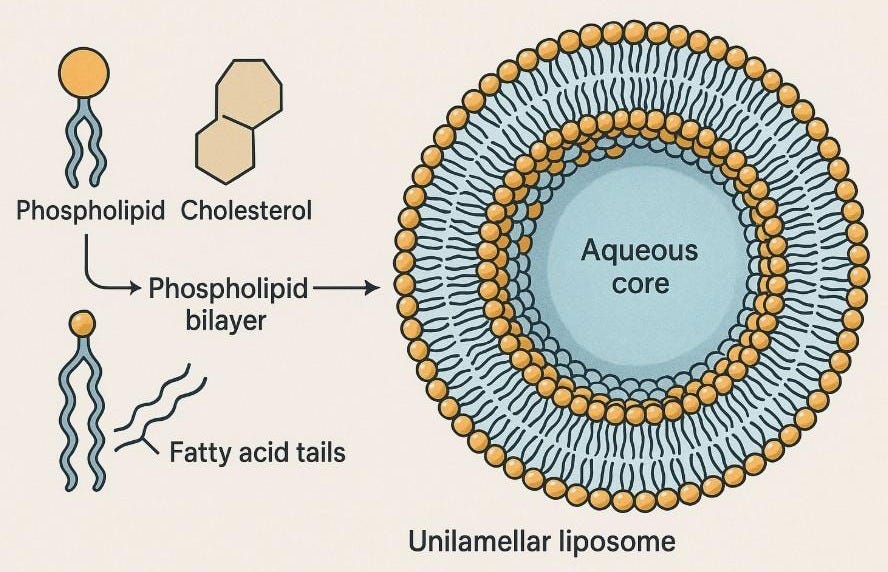
This isn’t a new concept – liposomes were first developed in pharmaceutical research in the 1960s and used in targeted drug delivery for decades. The research backing, particularly for Vitamin C, is substantive, with a strong base of published literature and serious pharmacological studies. Yet it wasn’t until the late 2010s that this form factor became popularized for supplements.
Brands like Cymbiotika and Sunny Within have built their entire identities around liposomal formulations, capitalizing on the scientific significance of liposomal delivery for key nutrients. Cymbiotika in particular has done effective brand-building around the science, making liposomal delivery feel aspirational rather than clinical. The format also lends itself to beautiful packaging – easy to squeeze gels, minimalist labels – which helps communicate the premium positioning that the actual science can justify.
As the category evolves, so will research. Brands will need to continue building out proof points that other nutrients have similar levels of bioavailability efficacy as Vitamin C has proven out in order to continue adapting in a landscape where science continues to evolve.
2. Buccal pouches
Few planned for nicotine pouches to become the gateway for a new generation of consumer health delivery, but Zyns proved something crucial: that a meaningful subset of consumers – particularly Gen Z – are willing to adopt a non-pill, non-drink form factor. And given that this habit is already established, there’s a whole world of possibilities of other nutrients that can be delivered the same way.
“The pouch is portable, precise, and repeatable,” says Brad Pyatt, Founder of IQ Pouch. “This is the only product you can control your dosage. We want you to choose how much you want to take every other hour.”
Pouches take advantage of the high permeability of the buccal mucosa – the tissue lining on the inside of the cheeks and gums – to bypass the digestive system and the liver’s metabolism. Compounds enter systemic circulation faster and more intact than something swallowed and digested, often reaching the brain faster and providing higher bioavailability.
What’s new is the application of this mechanism to consumer wellness ingredients: caffeine, nootropics, electrolytes, CBD, etc. IQ Pouch has built itself around paraxanthine, a caffeine metabolite intended to deliver cleaner energy without some of caffeine’s side effects. Competitors like Ultra are staking out similar territory, targeting the same high-performance consumers seeking to sustain mental focus and be at their best throughout the day.

One key challenge with pouches will be separating its association with nicotine. For some consumers, that association is a positive feature – pouches can act as a replacement for Zyns. For others, it’s a liability, dragging the format into uncomfortable territory around addiction and dependency.
“[Pouches are] moving beyond the nicotine adjacent framing,” said Sam Mitchell, co-founder of Zalt. “Right now, people see the product and immediately associate it with nicotine pouches…I do think that pouches are going to evolve because the form factor is so useful, fun and it truly works.”
Smart brands will work to establish the pouch as a wellness delivery system in its own right, gradually erasing the origin story to reclaim the narrative.
3. Functional gums
Gum is an iconic consumer staple – everyone knows Wrigley’s and Trident. We’ve been chewing gum our entire lives without explicitly recognizing it as a potential pharmaceutical vector.
“We chose gum because 99% of the population knows how to and / or already chews gum. It was something we didn’t have to habitually reintroduce,” says Vishar Yaghoubian, CEO and founder of Toothpod.
Chewing activates the salivary glands and increases blood flow to the oral mucosa. The act of mastication itself speeds up buccal absorption. As it turns out, a chewing motion that’s been part of human behavior for millennia is a surprisingly effective drug delivery mechanism.
“What counts is what ends up in your bloodstream,” said Dr. Daniel Sanders, founder and CEO of UltraOral. “That’s what’s bioavailable to your cells, your tissues, your organs of your body to do whatever, whether it’s to promote health… to mitigate disease…that’s the objective.””
The military figured this out first, testing the efficacy of caffeinated gum as early as the late 1990s. The compound was noted to deliver caffeine to the bloodstream ~4-5x faster than pills or coffee. It was then officially rolled out in 2004, later becoming marketed commercially as Military Energy Gum.
Neuro Gum, UltraOral, Clooudie, and Toothpod – to name a few – have since built consumer brands around this insight, and the category is expanding. CBD gum, melatonin gum, B12 gum, remineralizing gum – the surface area for functional gum is enormous, and it’s barely been explored. After all, the gum format is portable, socially invisible, and meaningfully faster than alternatives, and the barrier to adoption is next to none for a casual user.
4. Sublingual strips
When Listerine PocketPaks launched in 2001, it proved something remarkable: that people would accept a delivery format that disappeared on the tongue with no water, swallowing, or mess. The simplicity of it – putting a dissolvable strip under your tongue – normalized this format for Listerine for a generation. But what brands didn’t capitalize on for years was to push that format beyond breath freshening.
That is, until now. Consumer brands are now beginning to apply this logic to wellness use cases, taking advantage of the sublingual strip, or the area directly on the tongue. The sublingual route is fast, the blood vessel density under the tongue is high, and the compound reaches systemic circulation without the delay and degradation of the gut. There’s a reason why Suboxone, medication used in opioid addiction treatment, and Zofran, an anti-nausea drug, are delivered this way.
“There are so many ingredients out there that you can do so much with if it didn’t break down in your stomach,” said Lekha Vyas, founder of SynQ Wellness, “[This is] a very different form factor that the consumer is ready for.”
Sleep or Die has built a melatonin strip that dissolves in seconds and requires no water at bedtime. SynQ has combined existing trends for GLP-1s with an everyday strip that manages the body’s hunger cues.
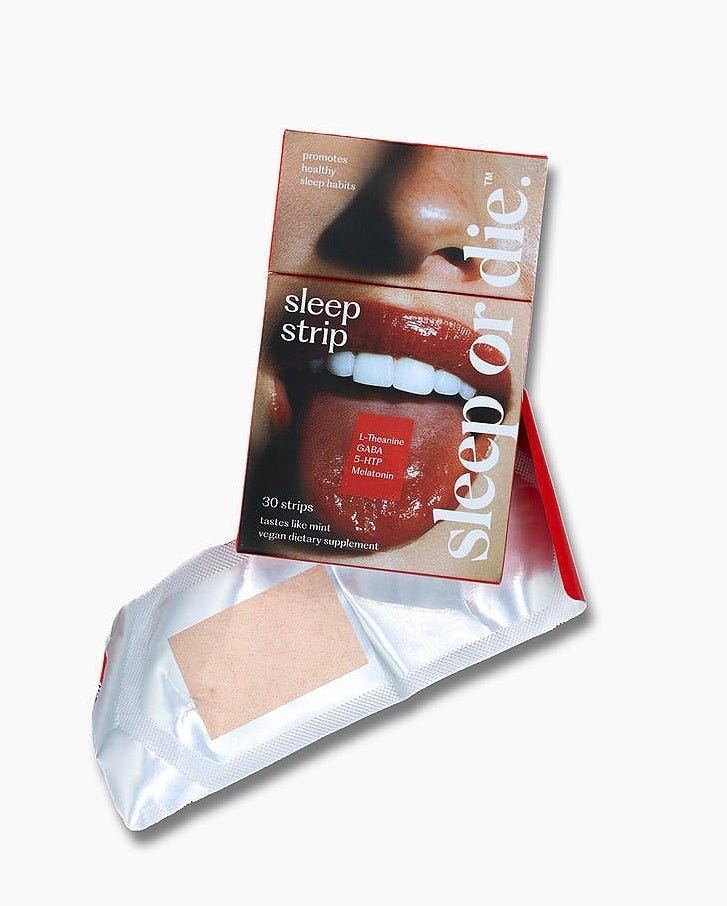
The brands that establish the strip as a serious delivery mechanism — not just a novelty — have an interesting structural advantage. The format is simple, easy to carry, and has proven clinical precedent. It’s now just waiting for its moment.
5. Transdermal patches
The skin is a remarkable barrier organ, specifically designed to keep things out. That said, the outer layer of skin is permeable to certain compounds, which means a category of molecules can pass through it and enter systemic circulation over time.
The scientific challenge has long been matching this format to the right compounds. Not everything can cross the skin, and the consumer wellness category has been littered with patch products that have made ambitious bioavailability claims science couldn’t support. The brands that will win in this space are the ones that choose their ingredients carefully, run the clinical work, and then invest in design good enough to justify the format. After all, a patch applied once a day is easier to maintain than a complex pill regimen.
At the same time, the consumerization of this format is what’s exciting about this space — and the extraordinary design opportunities that come with it.
Starface’s star-shaped pimple patches turned covering acne into a fashion statement. Suddenly the patch wasn’t something you hid; it was something you displayed. A generation of teenagers who grew up watching each other wear Starface patches learned something that previous generations hadn’t been taught: that acne didn’t have to be hidden.

That comfort is now available to be borrowed. Barrière has built vitamin patches with intentional fashion-forward design. Kind Patches have targeted, function-forward benefits intended to complement your everyday lifestyle. Patch Brand is working on transparent wellness patches that essentially disappear on the skin. The design vocabulary that Starface established – the idea that something on your skin can be aesthetically intentional rather than medically apologetic – is propagating.
As Alexa Adams, co-founder of Barrière put it, “How do we make [supplements] something that people want to use every day? [How do we] take it from ‘I have to take my vitamins today’ to ‘I get to wear my vitamins today?’ That’s where Barrière comes in.”
6. Wellness shots
The shot is the story of a form factor that has successfully scaled in the past two decades. 5-Hour Energy proved a behavioral model that the rest of the industry is still borrowing from: a small, concentrated, portable dose that can be consumed in seconds. The format fit well into the busy lives of corporate workers and the ritual of needing energy immediately – and they got that from a two oz bottle.
The wellness industry ran with this. Ketone IQ has built a daily ketone shot that functions like nootropic fuel, with the hypothesis being that ketones provide the brain with an alternative energy mechanism. Magic Mind delivers a mental performance shot with a blend of adaptogens, nootropics, and matcha. Both brands are making a claim that the shot isn’t just a delivery mechanism, but rather a part of a ritual.
“I think the shot set is destined to become the bridge between vitamins, supplements, and functional beverages, where you will see all the supplement functionalities that can be more effective in liquid form but don’t necessarily require 12+ oz,” said William Hicks, co-founder and CEO of Magic Mind.
There is a new template emerging for the consumer health brand, and it looks quite different from what came before. The most interesting observation, though, is how early many of these trends are.
The opportunity for founders in this space is specific: pick a delivery mechanism, nail the science behind it, and then make the design beautiful enough that people want to be seen using it. The brands that get all three right won’t just be selling supplements. They’ll be selling a new relationship with the body – one where taking something efficacious for yourself is the new norm.
The shape of health is changing. Brands are changing with that, too.
Thanks for reading. We’re Great Circle Ventures, a fund focused on emerging food tech and CPG brands. If you found this useful, hit subscribe below and follow us on IG (@greatcirclevc). And if you’re a founder working on a novel form factor, we’d love to hear from you.
 | A guest post by
|
 | A guest post by
|
I love that Toothpod is here
Amazing read! So many cool formats making supplementation fun and easy for everyday lives.